Characterization of the air–sea exchange mechanisms during a Mediterranean heavy precipitation event using realistic sea state modelling
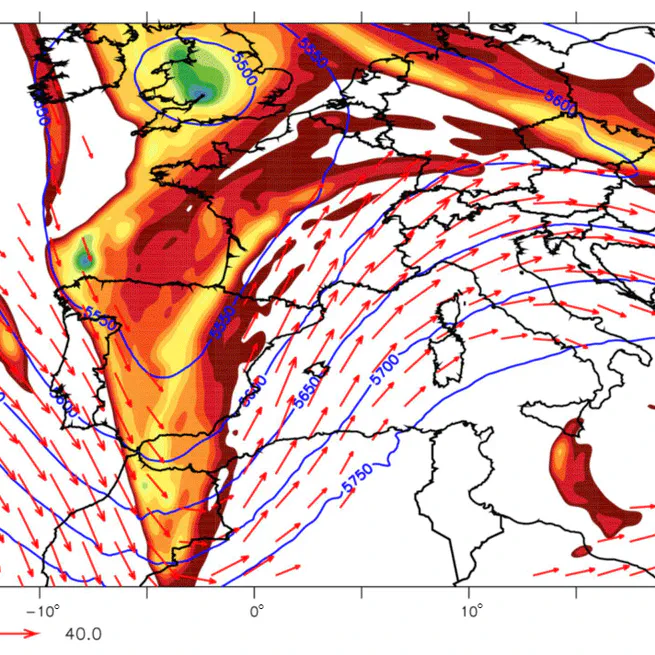
This study investigates the mechanisms acting at the air–sea interface during a heavy precipitation event that occurred between 12 and 14 October 2016 over the north-western Mediterranean area and led to large amounts of rainfall (up to 300 mm in 24 h) over the Hérault region (southern France). The study case was characterized by a very strong (>20 m s−1) easterly to south-easterly wind at low level that generated very rough seas (significant wave height of up to 6 m) along the French Riviera and the Gulf of Lion. In order to investigate the role of the waves on air–sea exchanges during such extreme events, a set of numerical experiments was designed using the Météo-France kilometre-scale AROME-France numerical weather prediction model – including the WASP (Wave-Age-dependant Stress Parametrization) sea surface turbulent flux parametrization – and the WaveWatch III wave model. Results from these sensitivity experiments in the forced or coupled modes showed that taking the waves generated by the model into account increases the surface roughness. Thus, the increase in the momentum flux induces a slowdown of the easterly low-level atmospheric flow and a displacement of the convergence line at sea. Despite strong winds and a young sea below the easterly flow, the turbulent heat fluxes upstream of the precipitating system are not significantly modified. The forecast of the heaviest precipitation is finally modified when the sea state is taken into account; notably, in terms of location, this modification is slightly larger in the forced mode than in the coupled mode, as the coupling interactively balances the wind sea, the stress and the wind.
Feb 11, 2020
Ocean-atmosphere coupling for prediction of Mediterranean heavy precipitation events : better modeling and impacts of river runoff and sea state
The Western Mediterranean Sea area is frequently affected in autumn by heavy precipitation events (HPEs). These episodes, characterized by strong offshore low-level winds and heavy rain in a short period of time, can lead to severe flooding and wave-submersion events. This thesis work aims to progress towards integrated short-range forecast system via coupled modeling for a better representation of the processes at the air-sea interface. The methodology consists in studying the impact of a realistic representation of freshwater flow into the ocean, then examining the impact of better taking into account the sea state, particularly through coupling.In a first part, we evaluated the sensitivity to different river flow representations in the NEMO ocean model during the HyMeX campaign (SOP1, fall 2012). For this purpose, two ocean configurations were used, WMED (1/36°) covering the Western Mediterranean Sea and a new configuration: NWMED (1/72°) covering the Northwestern Mediterranean Sea. Three river discharge forcings are used: a monthly climatology as well as daily and hourly observations. The results showed a significant local impact on the ocean stratification when river discharge observations are used compared to climatology. The surface salinity is modified as well as the mixing layer, becoming thinner, delimited by a well marked halocline. Secondly, we focused on a HPE that occurred between October 12 and 14, 2016 in the south of France. In order to study the role of sea state in air-sea exchanges, a set of numerical simulations was carried out with the Météo-France AROME kilometric atmospheric model - including the turbulent sea surface fluxes parameterization WASP - forced or coupled with the WaveWatchIII wave model. The results showed that taking sea state into account has a significant impact on the lower levels of the atmosphere, reducing the surface wind speed and modifying the precipitation forecast over sea, particularly the location. In the third part of the thesis, we evaluated the contribution of ocean-atmosphere-wavecoupling. In order to identify and quantify the coulping impacts, coupled ocean-atmospherewave simulations were performed using the coupled NEMO-AROME-WaveWatchIII system and notably compared to coupled atmosphere-wave and ocean-atmosphere simulations. The results showed, first of all, that the forecast is sensitive to coupling, and that the interactive coupling with the ocean leads to significant changes in the heat and moisture supply of HPE, while coupling with a wave model mainly leads to changes in the low-level dynamics. These results were finally compared with atmospheric sensitivity tests to the turbulent sea surface fluxes parameterization and to SST. It emerges that the choice of the parameterization can be of great importance for the HPE forecast as large as the coupling with an interactive ocean, whereas the dynamic effect is only produced by considering waves forcing/coupling.
Dec 11, 2019
Impact of the representation of the freshwater river input in the Western Mediterranean Sea
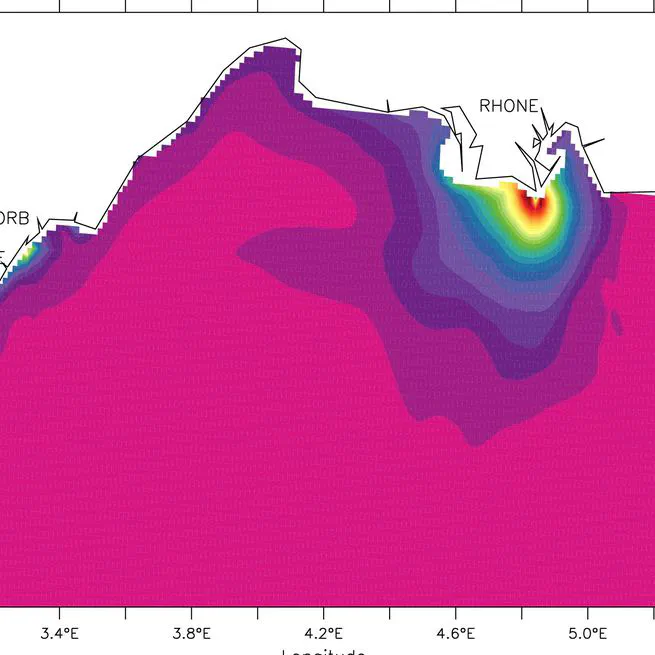
The Western Mediterranean Sea is often affected by heavy precipitation which frequently generates floods or even flash floods. These events generally produce brief but major freshwater inputs in the ocean. In order to evaluate the sensitivity to the representation of river freshwater input, three different runoff forcing dataset are used to drive the NEMO ocean model: a monthly climatology, an observational dataset with a daily or a hourly frequency. The sensitivity is investigated over the first Special Observation Period (SOP1) of the HyMeX program that took place in autumn 2012, in two configurations of NEMO: the first is WMED36 over the Western Mediterranean Sea at 1/36°-resolution and the second is a new configuration covering the North-Western Mediterranean Sea with a 1/72°-resolution named NWMED72. With NWMED72, the impact of the representation of the river freshwater flux, i.e. moving from a surface flux to a vertical distribution of the flux, is also evaluated. The results show that the ocean stratification is significantly modified locally in simulations where runoff observations are used compared to those using the climatology. The sea surface salinity is modified as well as the mixed layer which is thinner as bounded by a well marked halocline. The sea surface temperature is also impacted by the change in runoff frequency. Moreover, the current intensity in river plume during flood is increased. Vertical profiles of salinity and temperature and thus the mixed layer depth are changed when the runoff forcing is distributed over a depth. Those changes are limited and very local but the realism of the river runoff input is improved.
Sep 12, 2018